Visualize Success with a Business Infographic Template
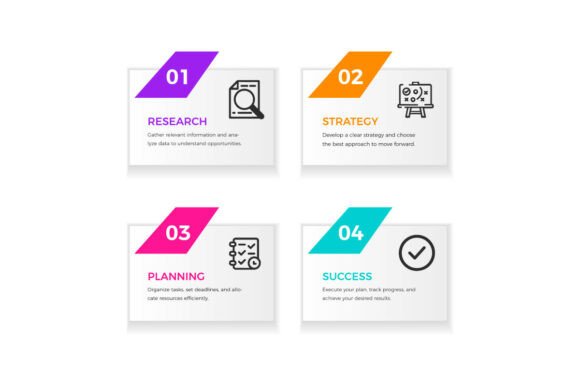
In the fast-paced world of digital marketing and corporate communication, clarity is currency. You might have the most groundbreaking data or the most innovative workflow, but if your audience can't digest it quickly, the message gets lost. This is where a well-crafted Business Infographic Template becomes an indispensable asset. It isn't just about making things look pretty; it's about structuring information in a way that guides the eye and simplifies complex narratives. Specifically, templates featuring four rectangular cards for workflow visualization offer a structured yet flexible approach to storytelling that resonates with professionals across industries.
When you download a package containing AI, EPS, and Preview JPEG files, you aren't just getting a static image. You are acquiring a scalable design system. The visual personality of these templates is typically clean, modern, and authoritative. They rely on strong geometric shapes—specifically those rectangular cards—to create distinct sections for information. This structure imposes a natural rhythm on the content, forcing the creator to be concise while allowing the viewer to process information in bite-sized chunks. The appeal lies in its versatility; whether you are a startup founder pitching to investors or a blogger explaining a DIY process, the layout adapts to your voice without losing its professional edge.
Structuring Workflows for Maximum Impact
The core strength of a Business Infographic Template built around four steps is its ability to map out a journey. Human brains are wired to recognize patterns, and a four-step progression feels complete without being overwhelming. Think of it as the Goldilocks zone of data visualization: not too short to lack detail, not too long to lose attention. These rectangular cards act as containers for your key points, creating a clear visual hierarchy that tells the viewer exactly where to look next.
For entrepreneurs and marketers, this format is ideal for outlining service processes. Imagine a consulting firm explaining their "Discovery, Strategy, Execution, and Review" phases. Each rectangular card can house an icon, a bold headline, and a brief description. Because the files are provided in vector formats like AI and EPS, you have total control over every element. You can resize the cards to fit a wide website banner or stack them vertically for a mobile-friendly social media post without losing a single pixel of quality. This scalability is crucial for maintaining brand identity across different platforms, from a printed annual report to an Instagram story.
Designers will appreciate the underlying grid system that usually governs these templates. Even if you strip away the colors and icons, the alignment of the four cards provides a solid foundation for editorial design or packaging design inserts. The rectangular shape suggests stability and reliability, traits that any business wants to project. When you pair this structural integrity with a thoughtful choice of modern typography, the result is a piece of communication that feels both premium and accessible. It moves away from the cluttered, chaotic visuals often seen in amateur designs and leans into a minimalist aesthetic that says, "We know what we are doing."
Practical Applications Across Creative Industries
The utility of a Business Infographic Template extends far beyond the boardroom. While corporations use them for internal training and quarterly reviews, the application spectrum is vast for creatives and small business owners. Consider a health coach mapping out a client's transformation journey, or a software developer documenting a bug-fixing protocol. The four-step layout is universal enough to handle almost any sequential data.
In the realm of web design and social media graphics, these templates serve as high-engagement assets. Algorithms favor content that keeps users on the page, and infographics do exactly that by encouraging scanning and reading. A blogger can take a dense how-to article and distill the main points into a single, shareable graphic. This not only improves the user experience on the blog but also increases the likelihood of the content being shared on Pinterest or LinkedIn, driving traffic back to the source.
For those involved in logo design or brand strategy, these templates offer a sandbox for testing color palettes and font pairing. Since the structure is already defined, you can experiment with different sans serif font options for headers and a readable serif font for body text to see what best matches the brand's personality. Does the brand feel tech-forward? Maybe a sleek, geometric typeface works best. Is it more traditional and trustworthy? A classic serif might be the right choice. The template allows you to iterate quickly, swapping out elements until the visual language aligns perfectly with the brand's core values.
Furthermore, the inclusion of EPS files ensures compatibility with a wide range of design software, making these design assets accessible even if you aren't an Adobe Illustrator power user. Many vector editors can handle EPS files, allowing crafters and hobbyists to customize the template for personal projects, such as planning a wedding timeline or organizing a community event schedule. The barrier to entry is low, but the perceived value of the output remains high.
Optimizing Readability and Professional Perception
A common pitfall in DIY design is neglecting readability in favor of style. A Business Infographic Template mitigates this risk by providing pre-defined spaces that naturally limit text volume. This constraint forces you to edit your copy down to its essence, which almost always results in clearer communication. When evaluating a template, look for sufficient whitespace within those rectangular cards. Crowded text kills engagement; breathing room invites the eye in.
Consistency is another major factor in professional perception. Using a standardized template ensures that all your communications look like they come from the same source. This builds recognition over time. If your audience sees a specific layout and color scheme, they should immediately associate it with your brand. This is the essence of effective brand identity. It's not just about the logo; it's about the entire visual ecosystem surrounding your message.
When choosing how to customize your template, consider the context in which it will be viewed. Will it be projected on a large screen during a presentation, or viewed on a smartphone while commuting? For digital screens, ensure your contrast ratios are high and your fonts are legible at smaller sizes. A display font might work beautifully for the step numbers, but ensure the explanatory text uses a highly readable commercial font designed for screen viewing. Testing your design on multiple devices before finalizing the export is a non-negotiable step for serious creators.
Licensing is also a critical consideration. Most premium templates come with a commercial license, allowing you to use them in client work or products for sale. However, always double-check the terms. Some licenses may restrict the number of end products or require attribution. Understanding these boundaries protects you and your clients from legal headaches down the road. When you invest in a high-quality package with AI, EPS, and JPEG files, you are essentially buying peace of mind and the freedom to create without limitations.
Ultimately, the goal is to make your audience's life easier. A well-executed infographic respects their time and intelligence. It takes the heavy lifting out of data interpretation and presents the facts in a digestible, engaging format. Whether you are refining a corporate workflow or launching a new marketing campaign, leveraging a structured Business Infographic Template is a strategic move that pays dividends in clarity, professionalism, and engagement.